
When a business needs Power BI or Microsoft Fabric work done, there are four usual routes: a contractor through a recruitment agency, a contractor or consultancy hired directly, a freelance marketplace, or a permanent hire. The day rate or salary is only part of the cost. This guide puts 2026 UK market numbers on each route, works through two examples and shows which option fits which situation.
Six months to October 2026. Sources listed at the end of the article.
Run your own numbers: the agency vs direct contractor cost calculator compares agency and direct costs for your day rate, markup and contract length, and explains the difference between markup and margin. To see who you would hire directly, read the consultant profile; consultancies needing extra capacity can see partner delivery support.
The four ways to get Power BI and Fabric work done
Contractor through an agency
The agency finds the person, adds a margin to every day worked and handles the paperwork. It is accountable for the placement, not the outcome.
See the cost →Contractor or consultancy, direct
You engage the specialist directly on a day rate or a fixed-scope statement of work. No margin, and the supplier is accountable for the delivery.
Hiring direct →Freelance marketplace
Upwork, Malt, PeoplePerHour and similar. Fast and flexible, with platform fees and vetting left largely to you.
When it fits →Permanent hire
Best for ongoing, business-as-usual work. Slow to fill, with placement fees and employer costs on top of salary.
Cover while you hire →What the Power BI market pays in 2026
ITJobsWatch tracks UK job adverts. For the six months to 28 October 2026, Power BI contract roles had a median day rate of £500, up 5% on a year earlier; the middle half of rates sat between £403 and £600, and the top 10% paid £675 or more. Outside London the median was £463. Demand is rising fast: 1,915 contract adverts mentioned Power BI in those six months, up 46% on the same period of 2025.
Permanent Power BI roles had a median salary of £55,000, with the middle half between £41,250 and £71,500. Advertised contract rates are normally what the contractor receives; when an agency is involved, the client pays a margin on top.
| Contract day rate | Permanent salary | |
|---|---|---|
| 25th percentile | £403 | £41,250 |
| Median | £500 | £55,000 |
| 75th percentile | £600 | £71,500 |
| 90th percentile | £675 | £87,500 |
Worked examples: what each route really costs
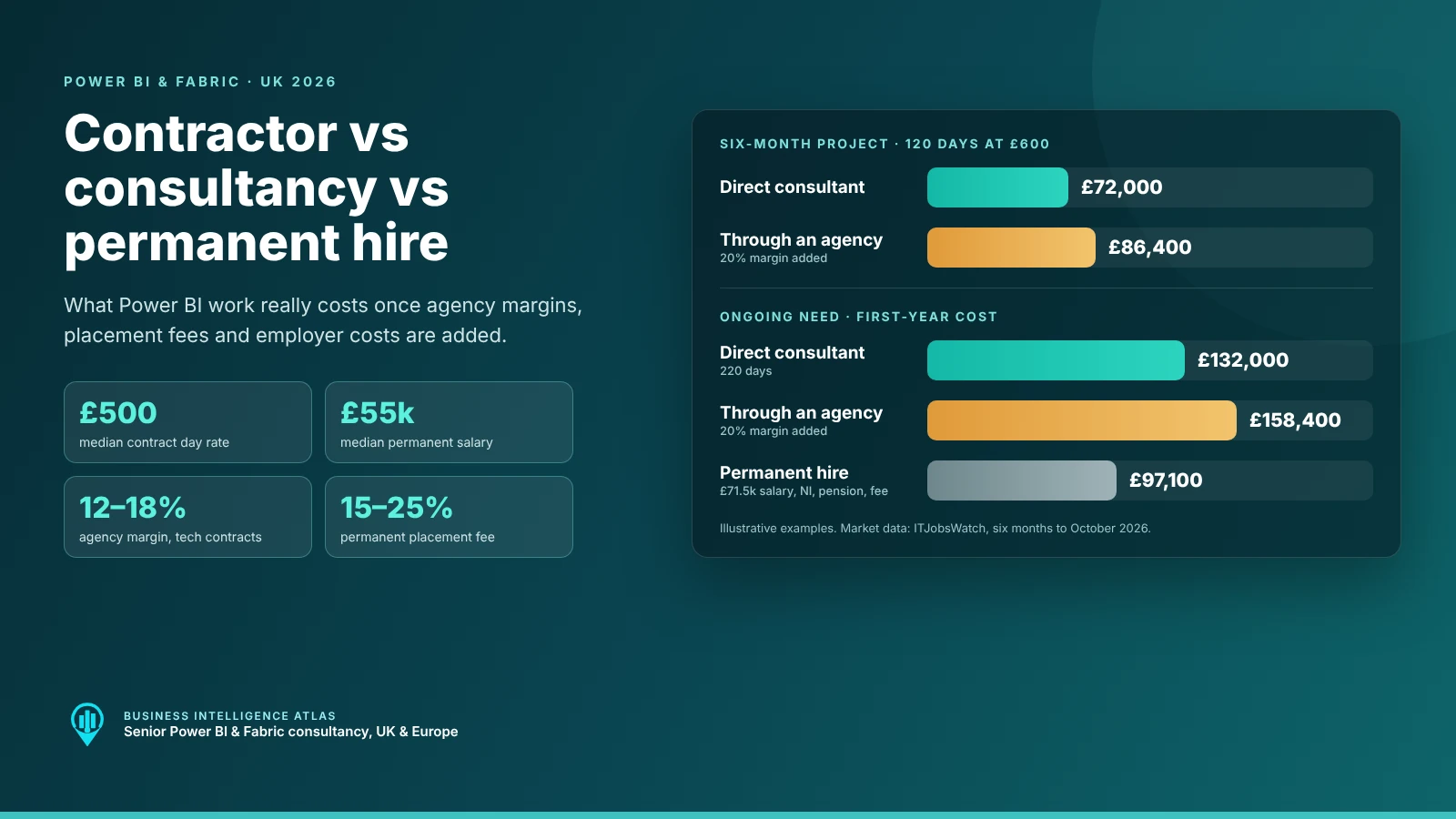
Example 1: a six-month project. A defined piece of work, such as a Fabric platform with finance reporting, needing around 120 working days of a senior consultant at £600 a day, around the upper quartile of the market.
The agency route costs about £14,400 more for the same person and the same days. A permanent hire is not a real option here: the work is finished before a typical hire would start.
Example 2: an ongoing, full-time need for a year. Around 220 working days of Power BI work, every year.
For steady, permanent work, an employee is cheaper over time, which is exactly why permanent roles exist. The catch is everything around the salary: three to six months to fill the role, the risk that the person cannot deliver end to end, and months in which the work does not get done. That is where interim cover while you hire fits.
Costs that do not show in the rate
- Ramp-up time: every new person needs weeks to understand your sources, models and definitions
- The wrong hire: a CV that matched the keywords but cannot design a model or reconcile to the ledger
- No accountability for outcomes: an agency is paid for the placement, not for working reports
- Knowledge walking out: undocumented models and pipelines leave with the contractor or employee
- Rework: fragile models and slow DAX that have to be rebuilt later
- Platform costs: poorly sized Fabric capacity and licensing can cost more than the consultant
IR35: why it pushes clients towards agencies, and what changed in 2026
Since April 2021, medium and large private-sector organisations have had to decide the IR35 status of contractors who work through their own limited companies. Many responded by routing contractors through agencies and umbrella companies, or by moving work to consultancies under a statement of work with defined deliverables. That is one reason agencies sit between so many clients and contractors today.
From 6 April 2026, the thresholds that define a small company for these rules rose to turnover of up to £15 million and a balance sheet of up to £7.5 million, with 50 employees or fewer (any two of three). More organisations are now small for IR35 purposes, so the off-payroll rules do not apply to them and the contractor’s own company assesses its status. Whatever your size, status depends on the real working arrangements. This is general information, not tax advice.
Which option fits which situation
| Situation | Best fit | Why |
|---|---|---|
| A defined project with a clear outcome | Fixed-scope statement of work, direct | Deliverables and acceptance criteria; the supplier owns the result |
| Extra hands-on capacity for weeks or months | Contractor hired direct | Same person, no agency margin |
| Permanent, business-as-usual work | Permanent hire, with interim cover | Cheapest over time; cover removes the gap while you recruit |
| Many contractors across many technologies at once | Recruitment agency | Agencies are built for volume and breadth |
| A small, well-defined fix | Health check or freelance marketplace | Low commitment and quick turnaround |
How to hire a Power BI contractor directly
FAQs
How much does a Power BI contractor cost per day in the UK?
The median UK Power BI contract rate was £500 a day in the six months to October 2026, with most between about £400 and £600 and the top 10% at £675 or more (ITJobsWatch). Through an agency, a margin is usually added on top.
How much do recruitment agencies charge?
Typical UK ranges are a 12–18% margin on technology contracts and 15–25% of first-year salary for permanent placements, depending on seniority and terms.
Is it cheaper to hire a Power BI developer permanently?
For steady, full-time, ongoing work, yes over time. For projects, peaks in demand or specialist platform work, a contractor or consultancy is usually cheaper because you pay only for the days needed.
Can I hire a Power BI contractor without an agency?
Yes. Many specialists and consultancies contract directly. You avoid the margin and speak to the person doing the work; you take on supplier onboarding and the IR35 assessment if you are a medium or large organisation.
What is the difference between a contractor and a consultancy?
A contractor usually provides one person’s time. A consultancy is usually engaged for an outcome, with deliverables, documentation and continuity. Business Intelligence Atlas offers both models, delivered by senior consultants.
Sources
- ITJobsWatch: Power BI contract job trends, UK (six months to 28 October 2026)
- ITJobsWatch: Power BI permanent job trends, UK
- Recruitly: recruitment agency fees in 2026 (agency margins and placement fees)
- YunoJuno: 2026 contractor rates report (permanent hiring timescales, direct contractor networks)
- Forvis Mazars: new IR35 off-payroll thresholds from 6 April 2026
Need Power BI or Fabric help without the agency margin?
Talk directly to a senior consultant about your project, your timescales and the best way to engage.
Comments are closed